How Much Exercise Does a Puppy Need?
A useful rule of thumb: five minutes of structured exercise per month of age, up to twice a day. A three-month-old puppy gets about fifteen minutes of leashed walking at a time, alongside plenty of free play it controls itself. The limit exists to protect growth plates, which do not close until 12 to 18 months in larger breeds.
Structured vs Free Exercise (the Distinction That Matters)
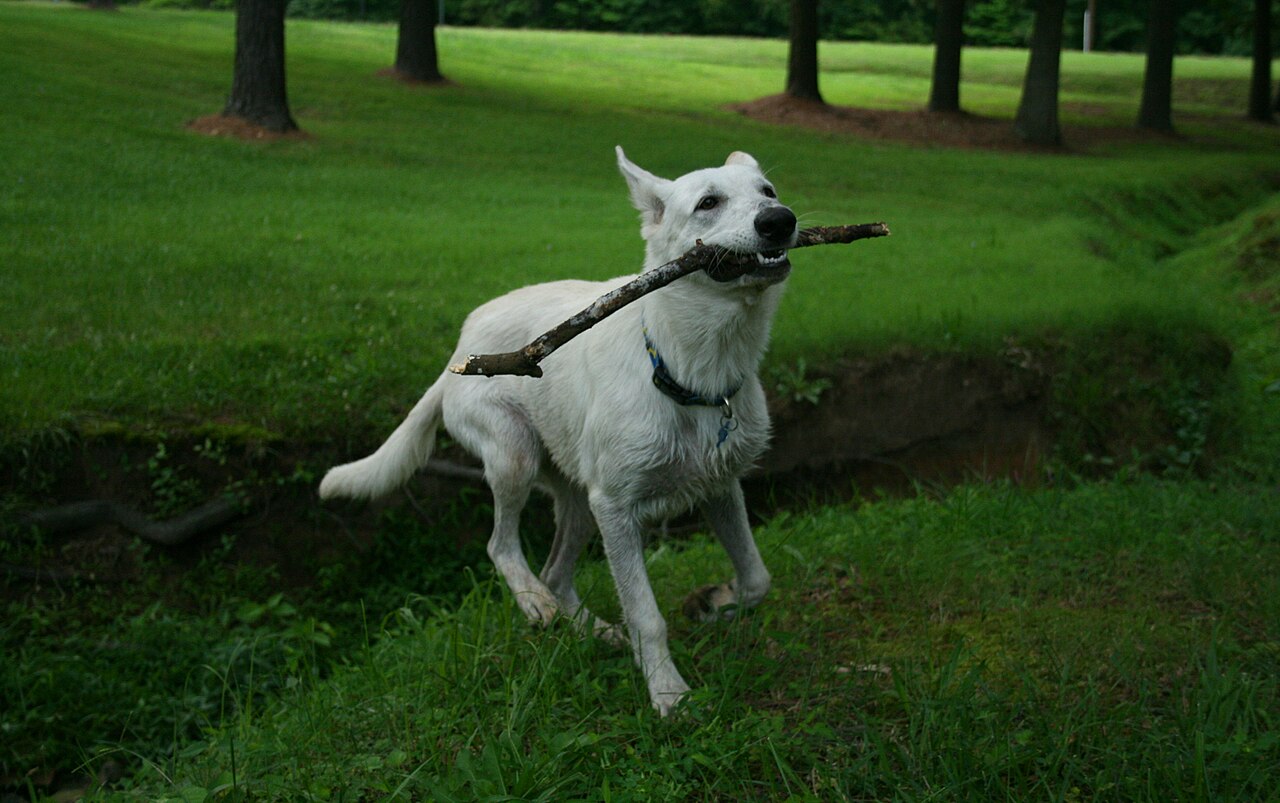
The five-minute rule applies to exercise you impose: leashed walks at your pace, jogging, anything repetitive on hard ground. It does not apply to what the puppy does on its own, because a puppy playing freely stops when it is tired, flops dramatically, and naps where it falls. Self-directed play in the garden, wrestling with a tolerant older dog, sniffing expeditions where the puppy sets the speed: all of that is nearly unlimited and exactly what growing joints are built for. What young joints are not built for is forced repetition. No jogging partners before the growth plates close, no stair sprints, no leaping for frisbees, and for large and giant breeds, think a Great Dane or Bernese, the caution extends to eighteen months, because those are the breeds where joint damage costs the most later.
The Exercise Nobody Counts
Here is the part that saves furniture: mental work tires a puppy faster than mileage. Ten minutes of training, a food puzzle, a cardboard box with kibble hidden in it, or a slow “sniffari” walk where the destination is irrelevant will buy you more calm than an hour of fetch, without a single joint impact. A puppy that is bouncing off the walls at 8 p.m. usually is not under-walked; it is under-occupied or, just as often, overtired and past the point of settling on its own. More running is the wrong prescription for both. Build in enforced naps (crates help; our crate guide explains the routine) and swap one walk for a brain game and watch the evening chaos shrink.
Scaling Up as They Grow
The allowance grows with the birthday: twenty minutes per session at four months, thirty at six. Somewhere between twelve and eighteen months, depending on size, the growth plates close and the ceiling lifts entirely; that is when the running shoes come out for high-energy breeds like the Border Collie or Vizsla. Until then, patience is cheap insurance. Plenty of the limping adult dogs in a vet’s Tuesday lineup were once puppies whose humans meant well and jogged too soon. Grow the dog first; the marathon partner comes free afterward.